
PMP
Pest Control Specialist
Pest Control Professional
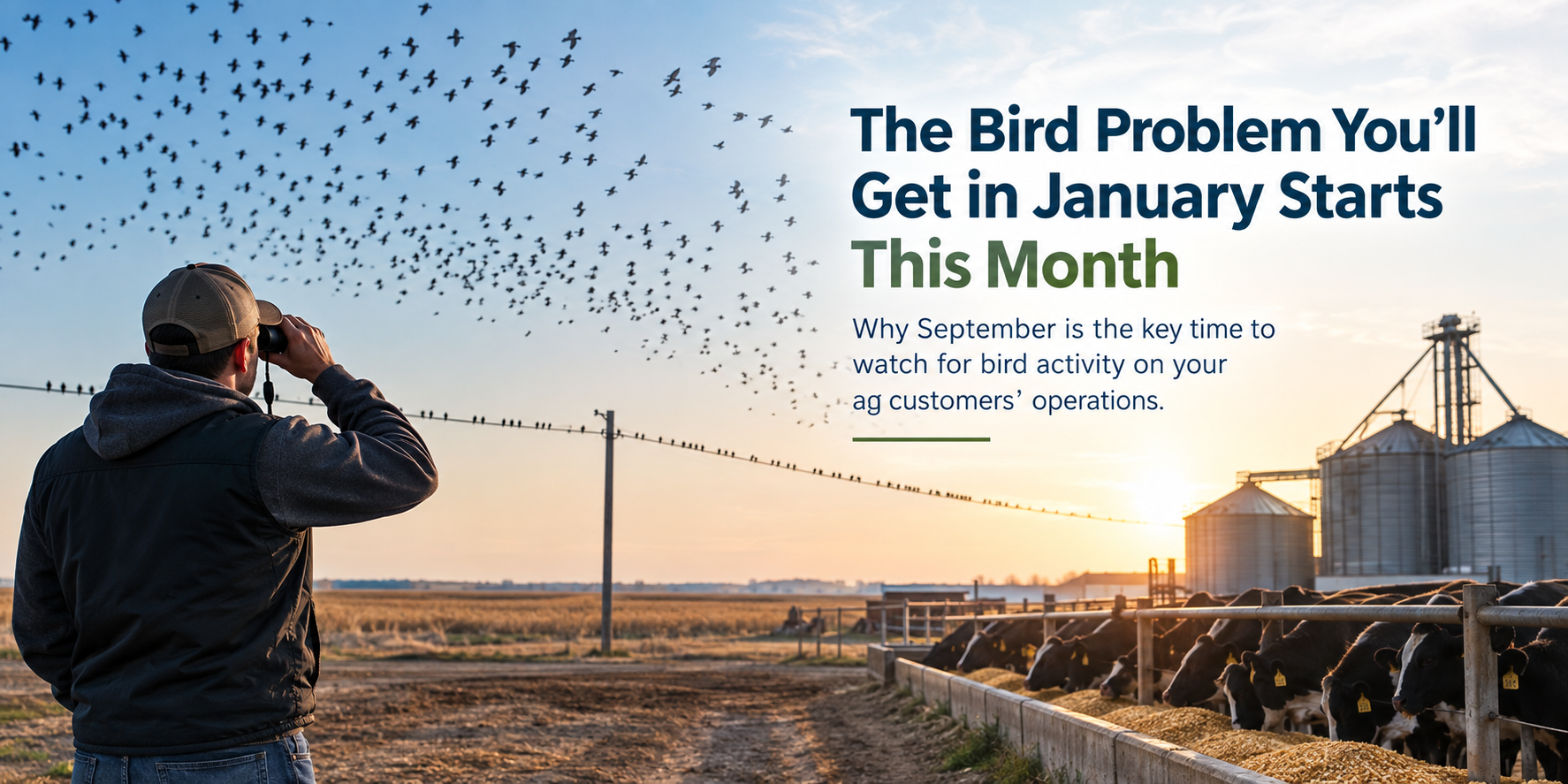

For dairies, feedyards, grain facilities, feed mills and livestock operations, September is the time to start looking for the bird problem, not waiting for it to arrive.
By January, the birds may already be a daily nuisance.
They may be sitting on feed lines, covering equipment, contaminating feed and gathering by the thousands.
But the warning signs often show up months earlier.
And September is one of the best times to start watching for them.
Fall migration brings a massive movement of birds across North America.
Cornell Lab of Ornithology research using weather radar estimates that roughly 4 billion birds migrate through U.S. airspace during fall migration. Other Cornell research puts the number of birds migrating over the U.S. each spring and fall at approximately 3 to 4.5 billion.
That doesn't mean 4 billion birds are headed for your customer's feedyard.
But it does mean the landscape is changing.
Birds are moving.
Flocks are forming.
And they're looking for the food, water and shelter they need to fuel migration and survive the winter.
For agricultural operations, that can make September an important month to start paying attention.
Right now, a customer may say:
"We really don't have a bird problem."
And they might be right.
There may not be thousands of birds sitting on the feed.
Yet.
But look around the property.
Are birds gathering on power lines?
Are large flocks working the harvested fields nearby?
Are they concentrated around grain, silage or other food sources?
Are they beginning to investigate the feed area?
Those observations can tell you much more than simply asking whether the customer currently has a bird problem.
You're looking for where the birds are positioning themselves before they become established.
Once birds discover an easy, reliable food source, an agricultural operation can become much more attractive than scattered food sources across the surrounding landscape.
This is particularly important with European starlings and blackbirds.
USDA's National Wildlife Research Center reports that European starlings, blackbirds and crows have winter populations estimated at 750 million to 1 billion birds in the U.S. The agency estimates their annual direct damage to grain, fruit and berry crops at more than $150 million.
And the problem isn't limited to crops.
USDA specifically identifies feedlots and dairies as locations where starlings and blackbirds congregate, consume livestock feed and contaminate feed with droppings.
That's where a bird problem can become an operational problem.
Research published in the Journal of Dairy Science found that European starlings selectively consumed the higher-energy portions of total mixed ration intended for dairy cattle.
In controlled experiments, the starling-consumed ration had lower available starch and crude fat. Modeling suggested that this nutritional change could potentially reduce dairy productivity.
That's an important distinction.
The cost isn't necessarily just:
"How much feed did the birds eat?"
It's also:
"What did the birds leave behind?"
If birds selectively remove the most energy-dense components of a ration, the remaining feed may not have the same nutritional profile that the producer intended to deliver to the cattle.
One study examining bird damage at commercial dairies in Pennsylvania, New York and Wisconsin found that bird-livestock interactions were associated with feed loss, increased operating costs and greater reporting of certain livestock pathogens.
Researchers modeled the economic effect of feed loss in 10 Pennsylvania counties and estimated total economic damage of $4.11 million to $12.08 million, with a mean estimate of approximately $10.6 million in 2009.
And that's just one regional analysis.
Another study at two Southwestern cattle facilities documented substantial feed disappearance during severe starling infestations. In one experiment, starlings consumed 2,327 kg of feed valued at $563 over 47 days, increasing daily production costs by approximately $0.92 per feedlot animal.
That may not sound enormous on one animal.
Multiply it across a large operation and an extended infestation, and the math changes quickly.
Feed loss gets most of the attention because it's easy to understand.
But birds can create other costs around an agricultural operation.
Large concentrations of birds can contribute to:
USDA notes that acidic bird feces can accelerate corrosion of fencing, corrals and other infrastructure at feedlots and dairies.
USDA also reports that a survey of Pennsylvania dairy producers found veterinary costs were 38% higher at dairies with starling flocks of 1,000–10,000 birds compared with dairies without starlings, $91 versus $66 per cow per year.
That doesn't mean every operation with birds will experience those exact costs.
It does show why a large, established flock shouldn't be treated as simply a nuisance.
You don't necessarily need to diagnose the entire bird problem during the first visit.
Start with observation.
Harvested fields and waste grain can provide an attractive food source.
Ask yourself:
Where are the birds feeding right now?
Large numbers of birds gathering on utility wires can be an early indication that you're dealing with a significant local population.
A few birds are one thing.
Large, recurring flocks are another.
Food sources can quickly become bird magnets.
Watch for birds repeatedly returning to grain storage, silage areas and other feeding locations.
This is one of the biggest questions to answer.
Are birds still outside the operation, or have they already discovered the feed?
If birds are already working the feed, the problem may be further along than the customer realizes.
Don't just watch where birds feed.
Watch where they go afterward.
Large flocks may travel between feeding locations and roosting areas, making the surrounding landscape an important part of understanding the problem.
On your next visit to a dairy, feedyard, grain facility or livestock operation, ask:
"Where are your birds sitting right now, out in the fields or already on your feed?"
That question can start a much better conversation than:
"Do you have a bird problem?"
Because the customer may say no.
But you might look around and see thousands of birds gathering just a short distance away.
That's an opportunity to catch the problem before the birds become established.
By winter, the bird pressure can be much more obvious.
But waiting until the problem is obvious also means waiting until the birds have already found the food source, established their patterns and become part of the customer's daily operation.
September gives you something valuable:
time.
Time to observe.
Time to identify where birds are feeding and roosting.
Time to talk with the customer.
And time to develop a management plan before a seasonal flock turns into a recurring operational problem.
The rep who notices the flock before it becomes a daily problem is the rep the customer remembers when the birds move onto the feed.
A whole lot of birds → Avitrol.