
Poultry Farms
Bird Flu
Avian Influenza
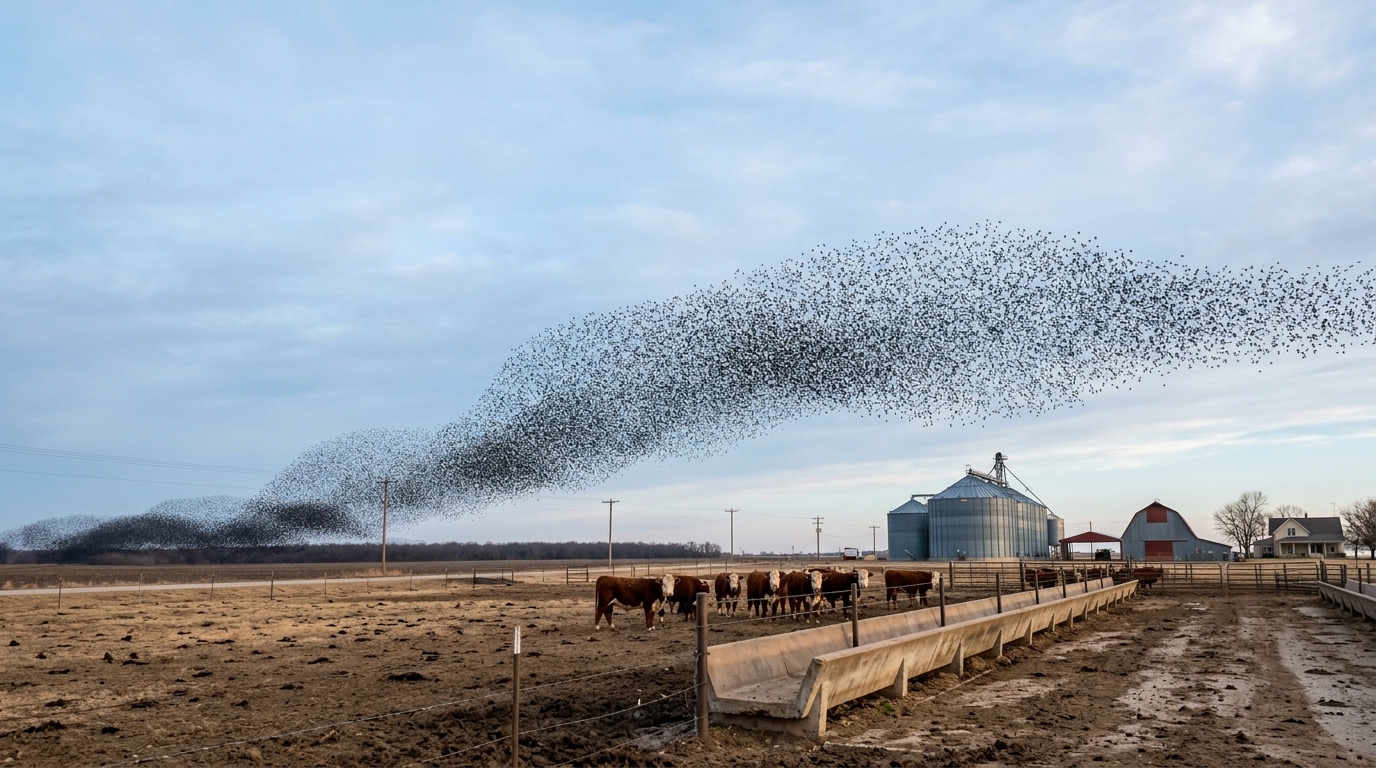

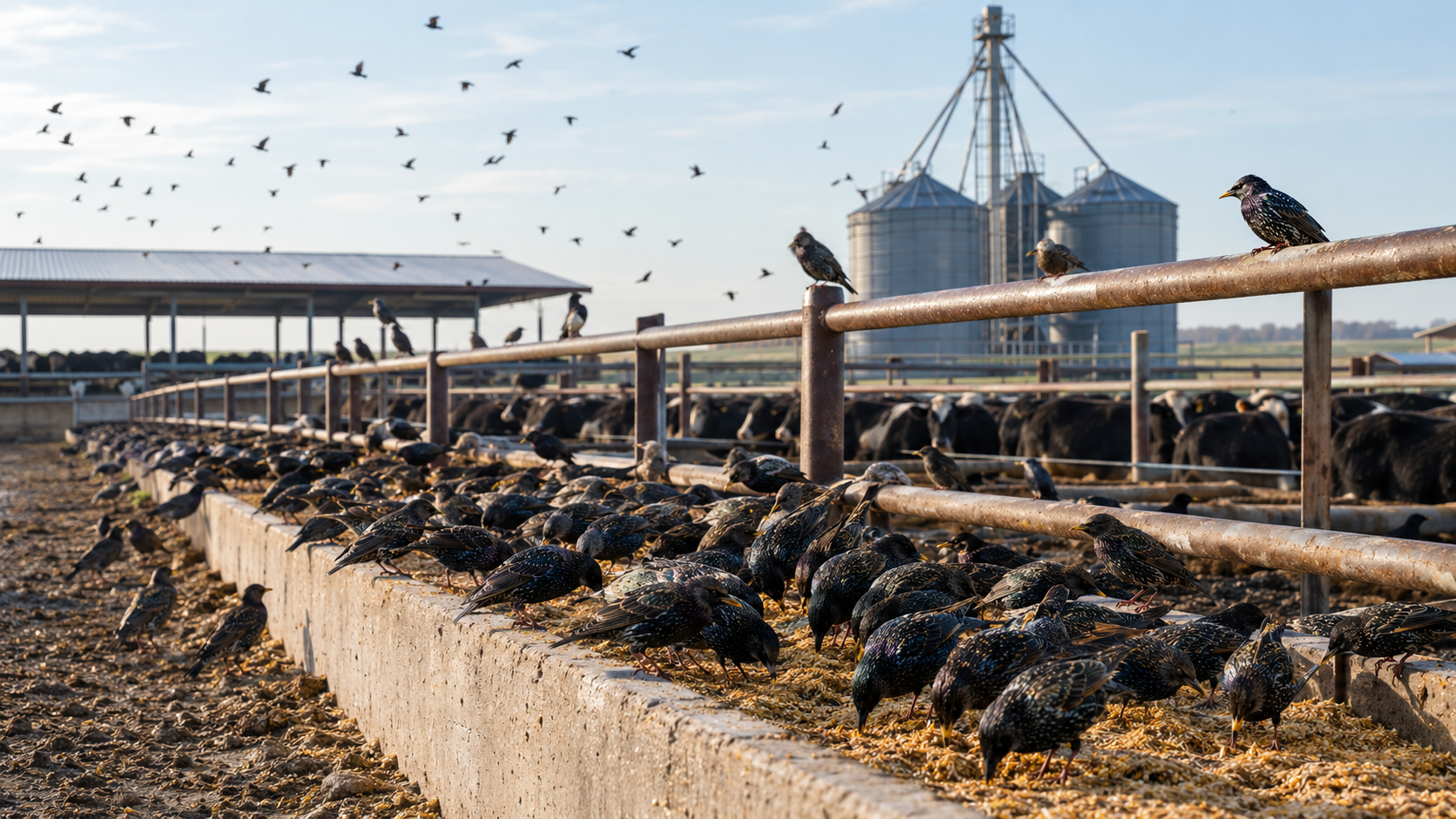
You arrive at a livestock facility and see hundreds of starlings covering the feed bunks, gathering along the fence lines, and moving around commodity storage areas.
The customer looks at the flock and says, "These birds just showed up."
But what if the birds have been using the property for weeks? What if they're traveling from a large communal roost miles away, following a regular route to a dependable food source?
According to the USDA's Wildlife Damage Management Technical Series: European Starlings, starlings leave their roosts around sunrise and generally travel directly to feeding sites. These feeding locations are usually within 15 miles of a roost, although some may be much farther away. Most birds arrive at feeding sites within a couple of hours after sunrise.
That matters when you're assessing a dairy, feedlot, or other agricultural account.
The flock you see on the property may be part of a much larger daily movement pattern. And understanding that pattern can help you determine why birds are gathering there, where they're feeding, and which areas deserve closer attention.
The goal isn't simply to find the birds. It's to understand why they're coming to the property.
To understand starling activity, you need to distinguish between two places birds use for different purposes.
Starlings often gather in large communal roosts during fall and winter. Depending on the location and season, these roosts may occupy trees, dense vegetation, bridges, buildings, or other suitable structures.
Some agricultural roosts can contain more than one million birds. That's not the typical size of every roost, but it demonstrates how concentrated starling populations can become.
When morning arrives, starlings leave their roosts and travel to locations where food is available.
For agricultural operations, that can include livestock feeding areas, feedlots, dairies, granaries, landfills, and other places where food is concentrated.
Livestock facilities can be especially attractive because open feeding systems may give birds access to high-quality cattle rations.
The birds don't necessarily need to nest, roost, or remain on the property all day for the facility to experience a problem. They may simply arrive, feed, and move on.
That's why seeing a flock at a customer's facility should prompt another question:
Where are these birds coming from, and what are they finding here?
Understanding that distinction helps you assess the customer's property as part of a larger landscape rather than treating it as an isolated bird problem.
Imagine visiting a feedlot shortly after sunrise.
You notice a steady stream of starlings approaching from the east. They descend toward the feed bunks, gather around accessible feed, and begin moving between feeding areas.
The direction of that movement gives you a useful observation: birds appear to be arriving from a particular part of the surrounding landscape.
It doesn't prove where the roost is located, but it gives you a starting point for investigating their movement.
For PMPs, this creates two useful observation windows.
In the morning: Watch where the birds enter the property and where they land first.
In the late afternoon: Observe whether birds leave in a consistent direction as they move toward roosting areas.
Over several observations, you may begin to recognize recurring patterns.
For example, you might discover that birds consistently approach a commodity bay from one side of the property, or that a flock arrives at the same feeding area around the same time each morning.
Those observations can help you narrow down where to focus your assessment.
Remember that wind, weather, food availability, disturbance, and changing flock behavior can affect movement. Some birds may arrive from different directions, and not every flock will follow the same route every day.
Treat direction as a clue to investigate, not proof of a specific roost location.
One of the easiest mistakes is to wait until the flock is already feeding before thinking about where it came from.
Instead, try observing the property before or around sunrise.
Here's what to look for.
Walk the property, where access is permitted, and identify locations that provide birds with easy access to food.
Look at:
Don't assume the largest flock is necessarily using every feeding area equally. Record where birds actually land and feed.
From a safe observation point, look for birds arriving from the surrounding landscape.
Are they appearing in one large flock? Are smaller groups arriving from several directions? Do they fly directly toward the feeding area, or gather on nearby roofs, power lines, or fences first?
Record the approximate time and direction of arrival.
The first landing area can help you understand how birds are using the property.
They may initially gather on a nearby structure before moving toward feed, or they may descend directly into an accessible feeding area.
Documenting those movements can help you identify the locations where further inspection is most valuable.
One morning provides a snapshot. Several observations provide a more useful picture.
If the customer reports that birds arrive every morning, ask whether you can arrange a site visit during that period. Compare the timing, direction, flock size, and feeding locations across visits.
A simple record of repeated observations can help establish whether the pattern is consistent or changing.
Knowing which direction birds arrive from is useful, but the feeding area is often the more actionable part of the assessment.
Starlings are attracted to dependable food sources, and agricultural operations can provide exactly that. USDA guidance identifies livestock facilities and other human-associated food sources as important starling feeding locations during fall and winter.
Once the flock arrives, ask what makes that part of the property attractive.
Is feed left exposed for extended periods? Are there spilled rations beneath a feed bunk? Is grain accumulating around a commodity bay? Are birds using multiple feeding locations throughout the operation?
These are practical questions that help move the conversation from bird activity to site conditions.
The direction of flight may help you understand where the birds are coming from. Their behavior after arrival helps you identify what they're doing on the property.
Both observations matter.
However, finding a likely feeding area doesn't mean every bird can be managed with the same approach. A good assessment considers the species, the scale of the problem, the facility's operations, and the management methods permitted at that location.
A customer may assume the birds are temporary visitors and that the problem will disappear on its own.
Sometimes flock activity does change as weather, food availability, and seasonal movement change. But when a facility offers a reliable source of food, birds may continue using the property for weeks or longer.
That creates an opportunity to help the customer make a more informed decision.
Instead of promising that birds will remain or disappear, show the customer what you've observed.
Explain when the flock arrives, where it gathers, which areas appear to attract it, and whether the pattern repeats across visits.
Then discuss the potential implications.
Those may include feed consumption, droppings around working areas, sanitation concerns, and the need to evaluate wildlife-related biosecurity risks.
The USDA identifies feed consumption, contamination, and potential disease transmission among the concerns associated with starlings and other blackbirds at livestock facilities.
The point is not to exaggerate the problem. It's to help the customer understand what is happening and determine whether a more detailed bird-management assessment makes sense.
For PMPs, a consistent pattern of bird movement can provide a natural reason to reconnect with an agricultural customer.
You don't need to arrive with every answer. Start by asking questions that help you understand the situation.
Try asking:
These questions encourage the customer to share what they have noticed and help you identify the next step.
You can also explain that a morning observation may reveal patterns that aren't obvious during a midday visit.
For example, a customer might see only a few birds around the feed bunks during an afternoon inspection, even though a much larger flock uses the facility early in the morning.
A properly timed site assessment can provide a more accurate picture of the activity.
From there, document your observations and discuss an appropriate management plan. Depending on the situation, that plan may involve reducing access to feed, improving sanitation, implementing exclusion measures, or evaluating other suitable bird-management methods.
The best recommendation is based on the actual site conditions, not simply the number of birds visible during one visit.
You don't need to locate a million-bird roost to put this strategy into practice.
Start with one agricultural customer who has reported starling activity.
Step 1: Ask about the morning.
Find out when the birds typically arrive and whether the customer has noticed a consistent direction of approach.
Step 2: Observe the pattern.
If possible, schedule a visit around sunrise. Record the approximate arrival time, direction of flight, and locations where the birds land.
Step 3: Identify the feeding areas.
Determine where the flock concentrates and what food sources or site conditions may be attracting it.
Step 4: Send the information to Lloyd or Solomon.
Include the account name and the direction the birds appear to be coming from. Add the approximate arrival time and primary feeding location if available.
Step 5: Decide what needs to happen next.
Use those observations to determine whether a more detailed assessment or bird-management discussion is warranted.
Your goal this week is simple: learn something about one customer's bird problem that you didn't know before.
When a customer says the starlings just showed up, don't stop at the observation.
Ask when they arrive. Find out which direction they come from. Watch where they land, and identify where they feed.
That means the birds on your customer's property may be part of a larger movement pattern extending beyond the facility itself.
You may not identify the roost on your first visit, and you don't need to. Start by understanding how the birds use the customer's property.
This week, ask one customer: "Which direction do the birds come from at sunrise?"
That one question could give you a better starting point for the next site assessment and a more informed conversation about bird control.