
Poultry Farms
Bird Flu
Avian Influenza

Bird control has traditionally been viewed as a building-maintenance issue.
Birds on a roof.
Birds nesting under signs.
Droppings on sidewalks.
Birds around loading docks.
But that way of thinking is becoming outdated.
Bird prevention is also a contamination-control, biosecurity, environmental, and operational issue.
A recent situation at Hoeya Lake in Ulsan, South Korea, provides a powerful example of why.
In August 2026, officials issued a harmful blue-green algae warning at Hoeya Lake after extreme heat and low water conditions contributed to a significant increase in harmful algae. It was the first such warning at the lake since 2009.
And here's the part facility managers should pay attention to:
The water authority had already been operating bird barriers and sprinkling systems at the dam since May as part of its efforts to prevent the spread of algae.
Officials were also testing raw and purified water weekly for algae toxins and odor-causing substances.
The lesson isn't that birds caused the algae problem.
They didn't.
The lesson is that wildlife management has become part of protecting critical infrastructure and water quality.
And that applies far beyond water utilities.
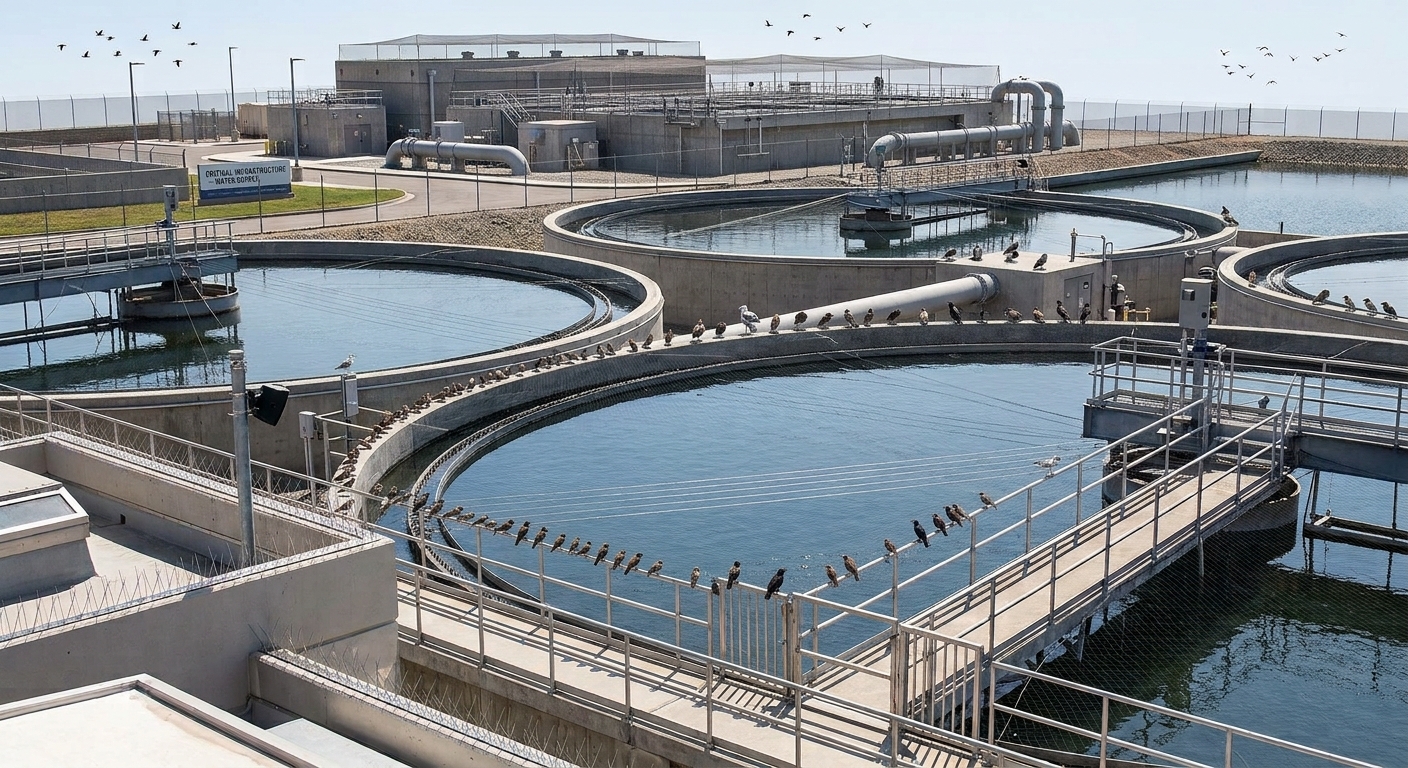
Water attracts birds.
Reservoirs, treatment plants, settling ponds, wastewater facilities, lagoons, retention ponds and other water infrastructure can provide birds with exactly what they need:
Water. Food. Resting areas. Shelter.
When large numbers of birds repeatedly congregate around a facility, the problem isn't simply what happens on the roof.
Birds leave behind feces, feathers, nesting material and other biological contaminants.
And when those materials enter areas where water is collected, processed, stored or transported, the consequences can become much more serious.
The CDC recognizes that contaminated environments can be an exposure concern for diseases such as highly pathogenic avian influenza. People can be exposed through contact with infected wild birds or environments contaminated by wild birds, including materials contaminated with feces, saliva or other secretions.
That doesn't mean every bird around a water facility represents a disease threat.
It means facilities should not wait for a contamination event before thinking about wildlife exclusion and bird pressure management.
Water treatment plants aren't the only places where bird prevention matters.
Consider a food-processing facility.
Birds land on the roof.
They nest around HVAC equipment.
They move between the roof, parking lot, loading dock and production areas.
They leave droppings on surfaces.
Eventually, what began as "a few birds outside" becomes a sanitation and contamination concern.
The same principle applies to:
If a facility has food, water, shelter or favorable nesting locations, it can become attractive to birds.
And once birds establish a reliable food or water source, simply removing the droppings isn't solving the problem.
You're cleaning up the symptom.
One of the biggest mistakes facility managers make is treating bird droppings as a cosmetic problem.
At the right facility, bird droppings can become a much bigger issue.
They can contribute to:
Sanitation concerns
Bird feces can contaminate surfaces, equipment and areas where food, ingredients or water are present.
Biosecurity concerns
Wild birds can carry pathogens, and contaminated environments can create exposure opportunities. The CDC specifically identifies contaminated environments associated with wild birds as a potential exposure concern for H5N1.
Water-quality concerns
Any facility where birds can access water sources should consider what happens when those birds repeatedly defecate, bathe or congregate around those areas.
Employee exposure
Employees who routinely clean heavily contaminated areas or work around concentrated bird activity may face unnecessary exposure to bird-contaminated materials.
Operational costs
Someone has to clean the mess, remove nests, repair damaged equipment and address recurring problems.
Reputation and liability
Customers, inspectors, employees and the public don't want to see large bird populations surrounding facilities that handle food, water or other sensitive products.
This is where prevention becomes so important.
A bird problem rarely starts with hundreds of birds.
It starts with a few.
A handful of birds discovers a reliable water source.
Then they find food.
Then they find a protected place to rest.
Then they begin returning every day.
Eventually, the facility becomes part of the birds' normal routine.
By the time management notices hundreds of birds, the birds may already have established the location as a dependable resource.
That's when bird control becomes much harder, and potentially much more expensive.
The better strategy is to identify the attraction points before the population explodes.
Bird prevention shouldn't be limited to the roof.
A comprehensive inspection should examine the entire property.
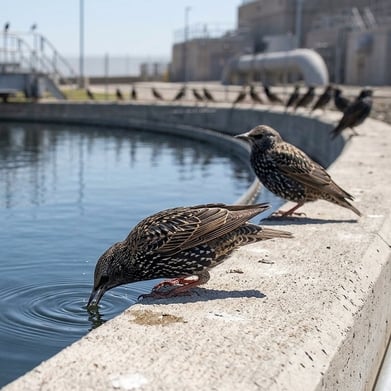
Look for:
Every one of these can become part of a bird's daily routine.
There is no single device that will solve every bird problem.
Successful bird management typically begins with understanding why the birds are there.
What are they eating?
Where are they drinking?
Where are they sleeping?
Where are they nesting?
What time are they arriving?
Where are they coming from?
Where do they go when they leave?
Once those questions are answered, a bird-management program can address the attraction points and use appropriate deterrents to make the facility less attractive.
That could involve exclusion, habitat modification, physical deterrents, bird pressure reduction and other professionally managed control strategies.
The goal isn't simply to make birds move from one side of the building to another.
The goal is to break the pattern that keeps bringing them back.
The situation at Hoeya Lake is a reminder that bird management can intersect with much bigger operational priorities.
A water authority dealing with a water-quality challenge isn't simply asking:
"How do we get birds off the building?"
They're thinking about protecting an important resource.
That's a very different way of looking at bird control.
And facility managers in other industries should adopt the same mindset.
Instead of asking:
"How bad do the birds have to get before we do something?"
Ask:
"What could happen if we let the birds establish this facility as a food, water or nesting destination?"
That question changes everything.
By the time birds are covering a roof, nesting inside equipment, contaminating water-access areas or creating daily cleanup problems, the facility is already reacting.
Preventive bird management allows facilities to identify the problem earlier.
That means looking for bird activity before migration peaks, before nesting sites become established, and before a handful of birds turns into a population.
With fall migration underway, that becomes especially important.
Millions of birds move across North America during migration, and facilities that provide food, water and shelter can become temporary or permanent stopping points.
The best time to address bird pressure is before the birds decide your facility is home.
The story from South Korea isn't simply a story about algae.
It's a reminder that wildlife management can be part of protecting critical infrastructure, water quality, sanitation and public health.
Water facilities have obvious reasons to take bird prevention seriously.
But the same principle applies to food plants, farms, warehouses, restaurants, distribution centers, manufacturing facilities and virtually any operation where bird contamination can create a financial, operational or regulatory problem.
Don't wait until the birds become the headline.
Identify what is attracting them.
Eliminate or reduce those attractions where possible.
And put a professional bird-management strategy in place before a manageable bird problem becomes a serious facility problem.
