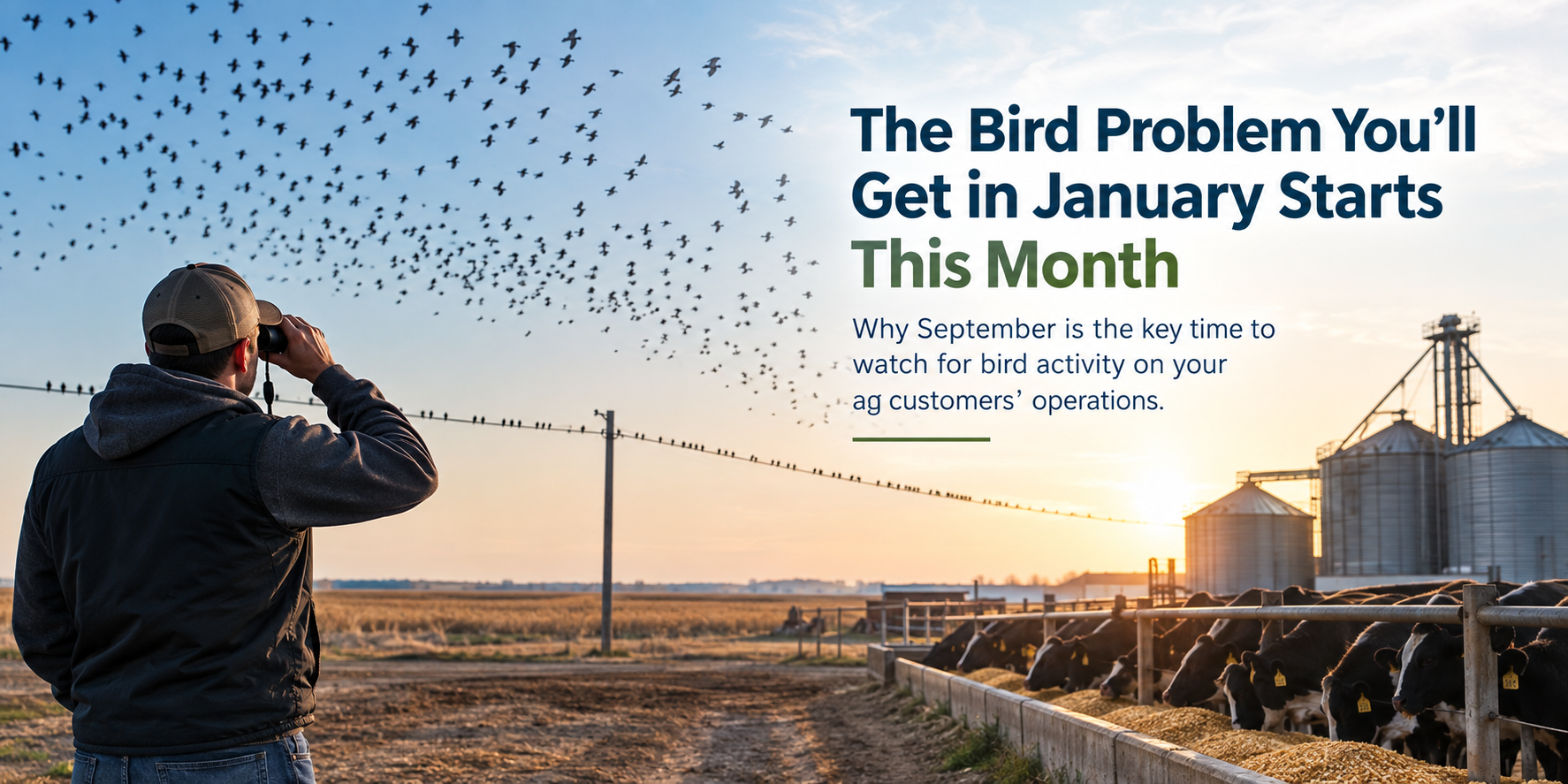
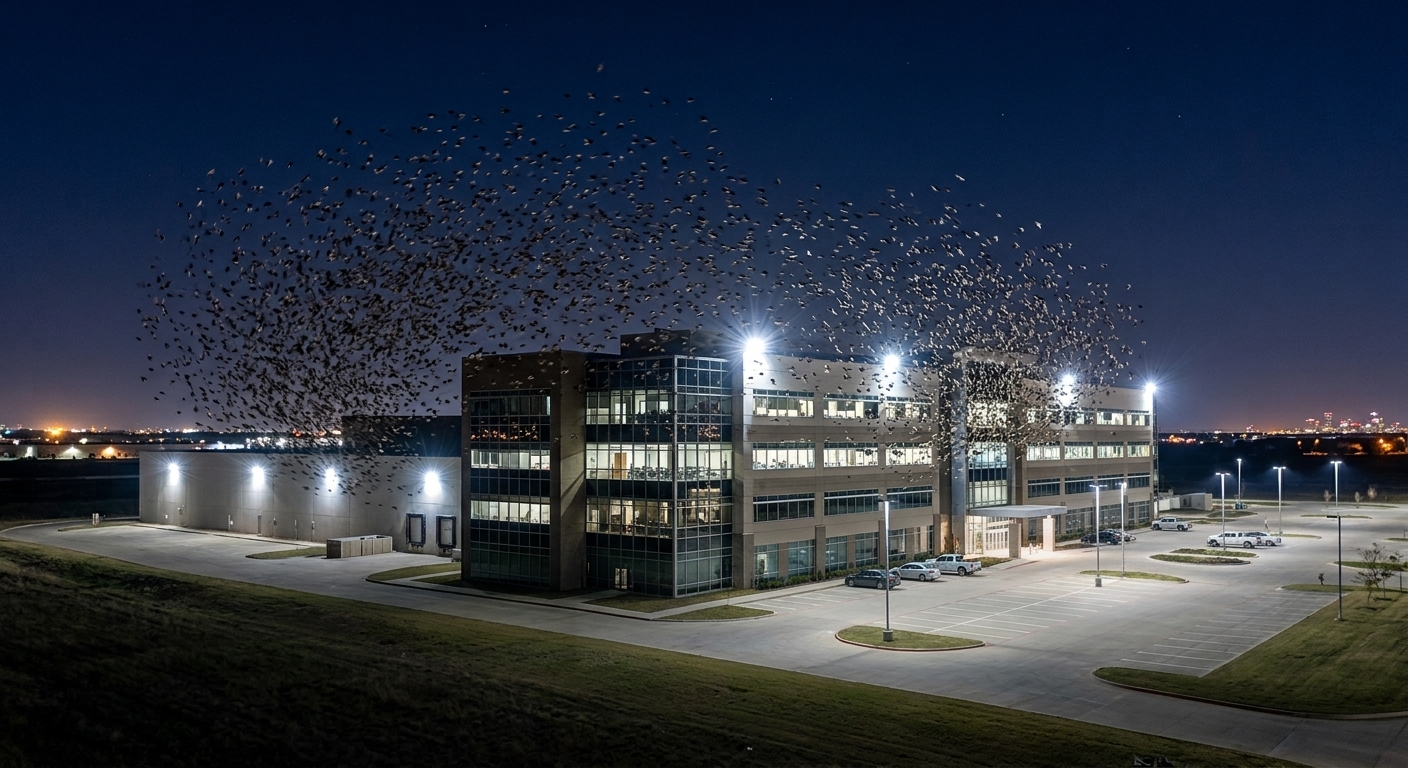
What if one of the things attracting birds to your facility at night is something you never thought about?
Your lights.
Every fall, millions of birds migrate across North America. Many travel at night, using environmental cues to navigate their journeys.
And when those birds encounter brightly lit buildings, parking lots, entrances and other structures, artificial light can interfere with that journey.
For facility managers, that creates a problem that goes beyond simply having birds on the property.
It can increase the potential for birds to gather around your building, and increase the risk of bird strikes.
So as fall migration gets underway, it's worth taking a look at something most facilities already have:
Their lighting.
Why Are Birds Around Your Building at Night?
Birds don't necessarily see your facility the same way you do.
You see a warehouse, office building, manufacturing facility or distribution center.
A migrating bird sees a landscape filled with different sources of light.
At night, bright artificial lighting can attract or disorient migrating birds, particularly when natural visibility is reduced by clouds, fog or other conditions.
And that can bring birds into areas where you don't want them.
Near buildings.
Around parking lots.
Around entrances.
Near rooftops.
And, in some cases, directly toward glass.
That's where things can get dangerous.
Your Exterior Lighting Could Be Part of the Problem
Take a walk around your facility after dark.
How much lighting do you have?
Think about:
- Parking lot lights
- Exterior wall lights
- Security lighting
- Loading dock lighting
- Building entrances
- Rooftop lighting
- Signs and illuminated displays
Now ask yourself:
Does every light need to be on all night?
I'm not saying you should turn off every light and leave your facility in the dark.
Security and employee safety obviously matter.
But there may be opportunities to reduce unnecessary lighting without compromising safety.
Motion sensors, timers, lighting controls, shielding and directional lighting can all help facilities be more intentional about where and when light is being used.
Bright Entrances Can Create Another Problem
Have you ever walked toward a building at night and noticed how bright the entrance is?
Now imagine you're a bird flying through the area.
A brightly illuminated entrance surrounded by darker conditions can stand out dramatically.
And if that entrance includes glass doors or windows, you've created another potential hazard.
Birds don't understand that glass is a solid surface.
They may see reflections of the sky, trees or surrounding landscape and attempt to fly through it.
The result can be a bird strike.
And during periods of heavy migration, the number of birds moving through an area can make this problem even more significant.
Glass + Light Can Be a Dangerous Combination
This is one facility managers shouldn't overlook.
Large glass buildings can reflect the surrounding environment during the day.
At night, interior lighting can make windows appear transparent from the outside.
Birds may see what looks like an open flight path when there is actually a pane of glass in front of them.
That means a facility's lighting strategy and its building design can work together to create a bird-strike risk.
This is particularly important for facilities with:
Large windows.
Glass atriums.
Glass walkways.
Glass entrances.
Reflective facades.
If you manage a building with significant glass, it's worth looking at the property from a bird's perspective.
Don't Forget About Overnight Operations
Here's another thing to consider:
Your facility may be brightly lit when most people aren't even there.
Some buildings operate around the clock.
Others have security lighting, signage or interior lights that remain on throughout the night.
If those lights aren't necessary for operations or safety, ask whether they need to remain on during periods of heavy migration.
This doesn't have to be an all-or-nothing decision.
Even reducing unnecessary lighting during the most active migration periods can be worth considering.
That's where a Lights Out approach can come into play.
What Is a “Lights Out” Strategy?
The basic idea is simple:
Reduce unnecessary artificial light during periods when migrating birds are most vulnerable.
Cities, businesses and organizations across North America have adopted Lights Out initiatives to help reduce risks to migrating birds.
For a facility manager, that could mean looking at:
- Which lights are essential?
- Which lights can be turned off overnight?
- Which lights can be dimmed?
- Which lights can be placed on timers?
- Can motion sensors replace lights that stay on continuously?
- Can fixtures be shielded or redirected?
- Are interior lights unnecessarily illuminating large glass areas?
The goal isn't simply to use less electricity.
It's about reducing unnecessary light that could interfere with migrating birds.
And as an added bonus, reducing unnecessary lighting can potentially reduce energy costs as well.
So What Does This Have to Do With Bird Control?
A lot.
Here's the bigger picture:
Bird control isn't always about what happens after the birds arrive.
It's about understanding why they're arriving in the first place.
If your facility provides food, water, shelter, roosting locations and attractive lighting, you're potentially creating an environment birds want to investigate.
That's why facility inspections should go beyond checking rooftops and ledges.
Look at the entire property.
Where are birds feeding?
Where are they drinking?
Where are they roosting?
Where can they nest?
And now, another question:
What is your facility doing at night that could be attracting or disorienting migrating birds?
A Simple Fall Lighting Audit
With fall migration underway, here's a simple exercise I recommend for facility managers:
Walk your property after dark.
Don't just look at it from inside the building.
Walk the exterior.
Look at your facility the way a bird might encounter it.
Pay attention to:
1. Bright exterior lights
Are they illuminating large areas unnecessarily?
2. Building entrances
Are entrances extremely bright compared with the surrounding area?
3. Glass surfaces
Are windows reflecting trees, sky or other areas that could confuse birds?
4. Interior lighting
Are large areas of the building illuminated overnight?
5. Loading docks
Are dock lights operating all night even when they're not needed?
6. Parking lots
Can lighting be reduced, redirected or controlled without compromising safety?
7. Signs
Are illuminated signs operating throughout the night?
You may discover opportunities you never noticed during the day.
Fall Migration Is the Time to Pay Attention
Here's why I'm bringing this up now.
September isn't just another month for facility managers.
Fall migration is getting underway.
Birds are moving.
They're searching for food and places to rest.
And they're encountering buildings, lights, glass and other structures along the way.
That means now is a good time to start looking at your facility before bird activity becomes a bigger problem.
Because the best time to identify a bird-control issue isn't after the birds have already established a routine.
It's before they do.
Look at Your Facility From a Bird's Perspective
Facility managers spend a lot of time thinking about their buildings from the human perspective.
Is it safe?
Is it clean?
Is it operating efficiently?
Is the equipment working?
But every once in a while, it helps to look at the property differently.
Look at it from a bird's perspective.
Where would you land?
Where would you eat?
Where would you find water?
Where would you shelter from the weather?
Where would you build a nest?
And at night...
What would you see?
Your facility might be doing more than you realize to attract birds.
Fall migration is already underway.
Now is the time to find out.
Final Thought
You don't have to wait until birds are covering your roof, loading dock or parking lot to start thinking about bird control.
Start with the basics.
Inspect the building.
Identify attractants.
Look for nesting and roosting locations.
And don't forget to look at what your facility is doing after the sun goes down.
Because sometimes, the thing bringing birds to your building isn't sitting on the roof.
It's shining from it.