Poultry Farms
Bird Flu
Avian Influenza
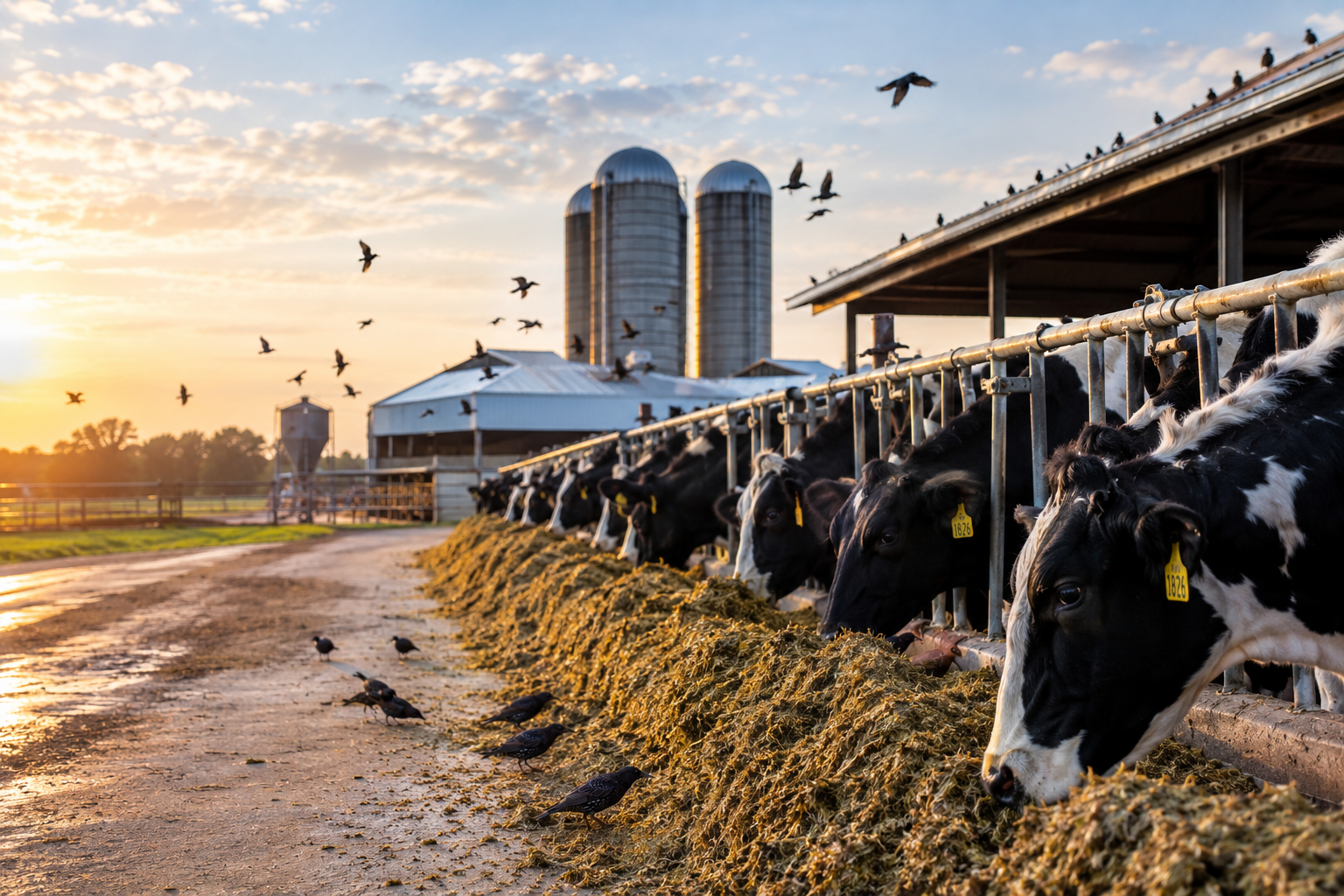

The U.S. dairy industry is producing more milk, and that means dairy operations have more to protect.
According to the USDA’s National Agricultural Statistics Service, U.S. milk production totaled approximately 20.1 billion pounds in July 2026, up 2.2% from July 2025. The number of milk cows on U.S. farms reached approximately 9.71 million head, an increase of about 199,000 cows from a year earlier. The increase in the national dairy herd is helping drive higher overall milk production, creating more feed, livestock and infrastructure to protect from bird-related damage and biosecurity risks.
A growing dairy operation has a lot of moving parts.
Feed deliveries arrive.
Grain and commodities are stored.
Cattle move through barns and holding areas.
Milk is collected and transported.
Waste is handled.
Water is consumed.
Equipment moves between different areas of the operation.
Every one of those activities creates potential attractants for birds.
Spilled grain can provide an easy food source.
Open feed can attract large flocks.
Water sources can become gathering points.
Manure and waste areas can attract birds looking for insects and other food.
Buildings provide protected locations for roosting and nesting.
And once birds discover a reliable food or water source, they can become remarkably persistent.
The bigger the operation becomes, the more difficult it can be to control those opportunities after birds have already established themselves.
Bird droppings are one of the most obvious signs of bird activity.
But the bigger concern for a dairy operation is what birds can potentially bring with them.
Wild birds can carry pathogens and contaminate environments through feces, saliva, feathers and other biological material.
That creates an important biosecurity consideration wherever birds have access to cattle, feed, water or production areas.
USDA APHIS states that H5N1 highly pathogenic avian influenza is present in wild birds worldwide and has caused outbreaks in U.S. domestic birds and dairy cattle.
The emergence of H5N1 in dairy cattle in 2024 demonstrated that avian influenza isn't simply a poultry issue.
It became a cattle issue, too.
The first reported U.S. dairy-cattle outbreak was identified in March 2024, and H5N1 has since been detected in dairy cattle in multiple states.
That changed the conversation around bird activity on dairy farms.
One of the biggest problems is also one of the simplest:
Food attracts birds.
Dairy cattle require enormous quantities of feed.
That can mean silage, grain, commodity ingredients and other feed materials moving through the operation every day.
Whenever feed is spilled, exposed or accessible, birds have an opportunity.
A few birds can quickly become dozens.
Dozens can become hundreds.
And during migration or periods of heavy bird activity, the numbers can increase dramatically.
Birds feeding around cattle feed aren't simply consuming something that belongs to the herd.
They are also moving through the same environment as the cattle.
That means droppings and other biological material can end up where feed is stored, handled or consumed.
For a dairy producer, that's a completely different level of concern than simply having to clean bird poop off a roof.
Birds also need water.
Dairy operations naturally provide plenty of it.
Water troughs, ponds, drainage areas and other wet locations can attract birds.
When birds repeatedly congregate around water sources used by livestock, they can create opportunities for contamination.
That is why reducing unnecessary wildlife access to livestock environments is an important component of biosecurity.
Minnesota's Department of Agriculture specifically recommends minimizing wild-bird access to dairy cattle and their environment as part of H5N1 biosecurity efforts.
The objective isn't to eliminate every wild bird from the surrounding landscape.
That's unrealistic.
The objective is to prevent unnecessary bird activity in the places where it creates the greatest risk.
Disease is not the only concern.
Birds can create operational problems throughout a dairy facility.
They can:
And there is an important economic point here:
None of those problems become cheaper when the operation gets bigger.
In many cases, the opposite happens.
Think about the chain reaction.
More cows require more feed.
More feed requires more storage.
More storage means more commodity handling.
More commodity handling creates more opportunities for spills.
More available food attracts more birds.
More birds create more droppings, nesting and contamination opportunities.
And once birds establish a dependable food source, removing them can become considerably more difficult.
That's why bird management should be proactive.
Waiting until a dairy has hundreds of birds around its feed areas is much different from identifying the attractants and correcting them before the flock becomes established.
The H5N1 situation is perhaps the clearest example of why dairy producers should take wildlife interaction seriously.
USDA has documented H5N1 in wild birds, mammals and dairy cattle.
The disease doesn't mean that every bird around a dairy represents an immediate threat.
It does mean that wildlife-livestock interaction deserves to be taken seriously as part of an overall biosecurity program.
A dairy producer already has enough variables to manage.
Feed costs.
Milk prices.
Labor.
Weather.
Animal health.
Processing capacity.
Transportation.
Market demand.
The last thing an operation needs is unnecessary exposure created by birds congregating around cattle, feed or water.
USDA's current dairy outlook projects approximately 236.6 billion pounds of U.S. milk production for 2026, with the agency expecting higher dairy-cow inventories to offset lower expected milk-per-cow yields.
That's a lot of milk.
And behind every pound of that production are cows, feed, facilities, equipment, labor and infrastructure.
As dairy operations expand, the cost of ignoring preventable problems can increase as well.
Bird control should therefore be viewed as more than an appearance issue.
It's about managing the environment around the herd.
It's about reducing unnecessary wildlife activity around feed.
It's about protecting equipment and infrastructure.
It's about maintaining sanitary conditions.
And when diseases such as H5N1 are part of the agricultural landscape, it's also about minimizing opportunities for wild birds to interact with livestock environments.
Birds are extremely good at finding food, water and shelter.
Dairy farms provide all three.
That's why a bird problem can develop faster than many producers expect.
A few birds around a feed area may not seem like a big deal.
But if they find a dependable food source, they can establish a routine.
Once that happens, the problem becomes much harder to ignore—and potentially much more expensive to correct.
More dairy production means more to protect.
More cows.
More feed.
More milk.
More infrastructure.
More economic value.
And more opportunities for birds to become a problem.
The smartest approach is to identify those opportunities before birds do.
Protect the herd. Protect the feed. Protect the facility. Protect the production.
Because when your operation is producing more, you can't afford to let preventable bird problems grow with it.