Bird Flu
Avian Influenza
Property Manager
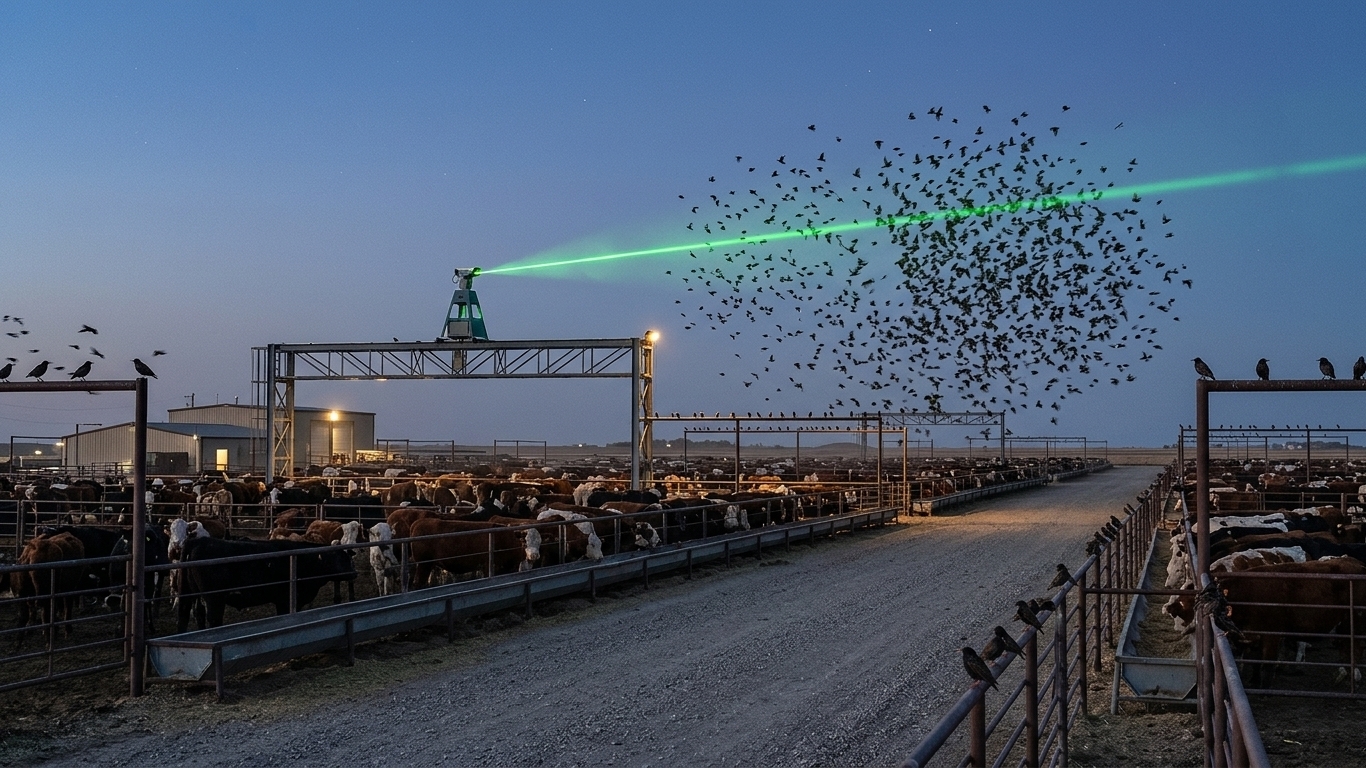

A feedlot can spend thousands of dollars every day feeding cattle.
But what happens when a portion of that feed never reaches the animals?
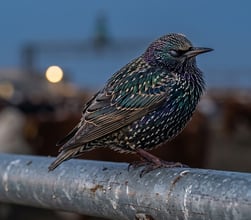
Starlings, blackbirds, and other pest birds can gather around livestock feeding areas, consuming grain, contaminating feed, and creating additional cleanup concerns.
And when thousands of birds repeatedly visit the same feeding areas, the financial impact can add up.
Bird control isn't just about getting birds off a roof or keeping them away from a building.
At a feedlot, it's about protecting the resources that keep the operation running.
Bird pressure can become a significant problem when livestock feed is readily accessible.
Open feed bunks, commodity bays, spilled grain, and feeding areas provide opportunities for birds to find food throughout the day.
One widely reported agricultural case study involved a California feedlot with approximately 15,000 starlings and gulls.
The operation reportedly experienced about $48,000 in annual bird-related feed losses before installing laser deterrents.
Following installation, the reported losses declined to approximately $12,000 annually.
That's a reported reduction of 75%.
The case demonstrates an important point:
Bird pressure can create a measurable financial problem for agricultural operations.
However, every facility is different. Bird populations, feed availability, facility layout, and management practices all influence how much damage birds cause.
The first step is understanding where birds are feeding and what they're costing the operation.
Laser bird deterrents have become an increasingly popular option for agricultural operations.
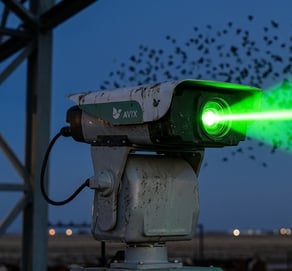
Automated systems project moving laser beams across targeted areas. Birds perceive the moving light as a threat and may leave the area.
These systems can operate automatically, reducing the need for someone to continually walk the property using handheld deterrents.
But there is an important consideration.
Laser bird control can require a substantial upfront investment.
Commercial automated laser systems can cost thousands of dollars per unit.
Publicly listed AVIX Autonomic Mark II prices provide examples of the investment:
These are advertised product prices, not universal installed costs. Actual pricing depends on the configuration, installation, electrical requirements, site conditions, and dealer services.
For a feedlot considering multiple units, the initial investment can become substantial.
And the purchase price isn't the only factor.
Producers should also consider installation, maintenance, coverage requirements, and whether the system addresses the bird species and locations causing the problem.
This is one of the most important questions agricultural producers should ask before investing in bird control.
Birds can become accustomed to deterrents when the threat becomes predictable.
For example, if a device repeatedly operates in the same pattern, birds may learn when and where it activates.
But laser technology deserves a more nuanced explanation.
Research does not show that birds inevitably become habituated to every laser system.
A 2026 systematic review published in the Journal of Applied Ecology evaluated 159 experiments involving laser deterrents.
The researchers found that lasers reduced bird occupancy by approximately 59% overall.
The review also found that evidence did not clearly demonstrate widespread habituation.
However, effectiveness varied according to bird species, environmental conditions, and how the laser was operated.
Other research suggests that predictable laser movements can increase the likelihood of birds becoming accustomed to the deterrent.
The practical takeaway?
A laser can be effective, but producers should not assume that every system will work equally well at every facility or indefinitely.
Bird control needs to account for the behavior of the birds, the conditions surrounding the operation, and whether the deterrent is addressing the actual source of attraction.
When agricultural producers evaluate bird control, they should consider more than one technology.
The best approach depends on the species, the location, the bird pressure, and the conditions creating the problem.
Avitrol offers agricultural bird-control products designed for specific bird-management applications.
Rather than requiring every operation to invest in expensive automated equipment, Avitrol may provide a different approach to managing certain pest-bird problems.
For agricultural operations dealing with eligible target species and suitable application sites, Avitrol can be a practical option to evaluate alongside other bird-control methods.
The important distinction is that bird-control products are not interchangeable.
A product must be appropriate for the target species, the application site, and the conditions described on its label.
Producers should work with a qualified, appropriately licensed applicator to determine whether an Avitrol product is suitable for their operation.
1. Evaluate the actual bird problem
Before choosing a solution, identify which birds are causing the damage.
Starlings, blackbirds, pigeons, and other species may behave differently and require different management strategies.
2. Look beyond the equipment purchase price
A bird-control decision should consider the total cost of the program, not just the price of a laser.
That includes installation, maintenance, labor, feed losses, and the consequences of continued bird pressure.
3. Choose a method appropriate for the site
Feedlots, dairies, grain facilities, and poultry operations have different requirements.
The bird-control strategy needs to fit the location and the species involved.
4. Combine bird control with facility management
Cleaning up spilled feed, managing water sources, reducing unnecessary bird access, and maintaining the facility can help reduce the conditions attracting birds.
No deterrent should be expected to overcome an unlimited supply of food and shelter without addressing those attractants.
When birds gather around livestock feeding areas, producers should ask three questions:
Where are the birds feeding?
What are they consuming?
And how much is that activity costing the operation?
Those answers can help determine whether an automated laser, an appropriately labeled bird-control product, exclusion, or a combination of methods makes the most sense.
Avitrol can be part of that conversation when the application is appropriate.
The goal is not simply to remove birds from one location.
It's to develop a bird-management strategy that protects feed, reduces unnecessary bird pressure, and fits the operation's needs.
Are starlings gathering around your feed bunks?
Are birds feeding in commodity bays or around grain storage?
Are you investing in bird-control equipment without knowing how much feed you're losing?
Start by identifying where birds are feeding and what is attracting them.
Then evaluate the available bird-control options with an experienced professional.
Contact Avitrol to discuss agricultural bird-control solutions and determine which options may be appropriate for your operation.
Bird ID is product ID.
The better you understand the birds, the better you can develop a plan to manage them.
Always follow the applicable product label, state and federal requirements, and directions from a qualified applicator.