Poultry Farms
Bird Flu
Avian Influenza

A customer says:
“We've got blackbirds everywhere.”
Before you recommend anything, take a closer look.
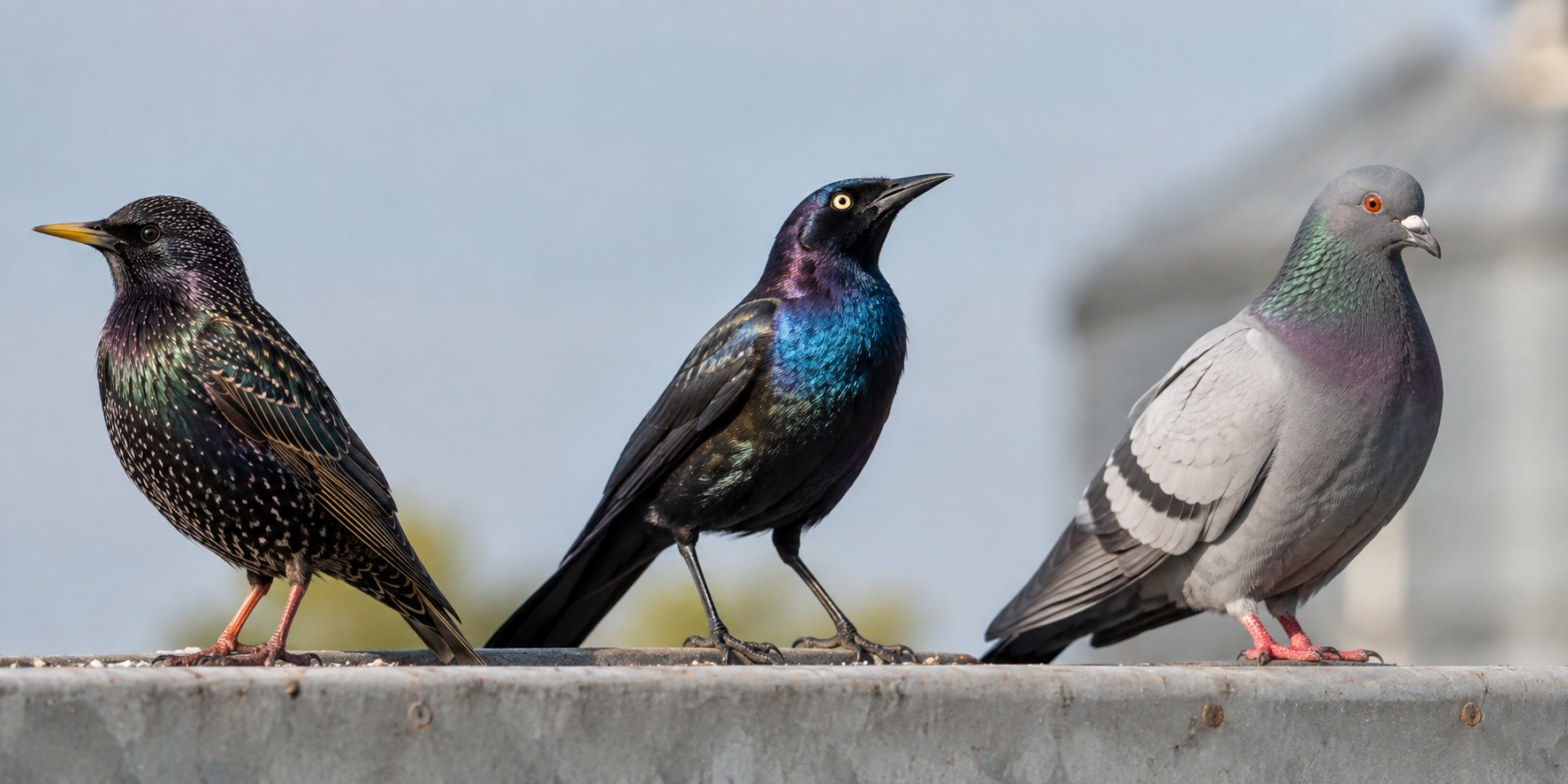
“Blackbirds” is often used as a catch-all term for several different birds. But a European starling, a grackle, and a pigeon are not the same bird, and identifying what you're actually dealing with can help determine what kind of bird-control conversation you should have next.
That is why one simple rule is worth remembering:
Bird ID is product ID.
The better you can identify the bird, the better you can understand the situation.
When you're talking with an ag customer, you don't necessarily need to be an expert birder.
Start by looking at three things:
Body shape.
Tail shape.
Behavior.
Those three clues can often help you narrow down what the customer is seeing.
Starlings are one of the birds you're likely to hear about when an agricultural customer starts talking about large numbers of birds around feed and livestock operations.
They're relatively compact birds with short tails and pointed heads and bills.
One of the easiest things to notice is how they move.
Starlings commonly walk around on the ground while looking for food rather than constantly hopping like many other birds.
Their plumage can also be distinctive. Adult European starlings are dark and glossy, with iridescent purple, green, and blue tones. During parts of the year, they can have noticeable light speckling across their bodies.
But behavior may be even more useful than color. 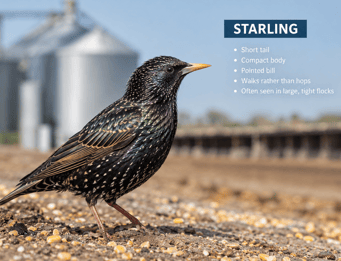
If a customer says they're seeing hundreds or thousands of small dark birds moving together around feed areas, starlings should be one of the birds you're considering.
Grackles can be confused with starlings because they're also dark-colored birds that can occur in groups.
But look at the shape.
A Common Grackle is generally larger and longer-bodied than a starling, with a noticeably long tail.
That tail is one of your best identification clues.
When viewed from the side or from behind, the tail can have a distinctive keel-like appearance.
Adult males can also have striking iridescent coloring, especially around the head and neck, ranging from blue and purple to green depending on the light.
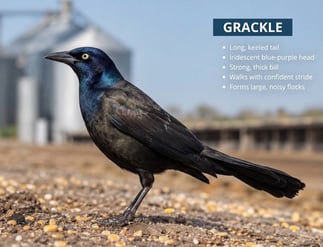
If the customer says:
“They're black, but they're bigger and have really long tails.”
You're probably having a different bird conversation than you would with a flock of starlings.
Then there's the pigeon.
Pigeons can sometimes get lumped into the same general category because customers may simply describe them as “birds” or “blackbirds.”
But they're easy to separate once you know what you're looking for.
Pigeons have a much different body shape, with a larger rounded body, relatively short tail, broad wings, and a thicker bill.
The familiar Rock Pigeon often has a gray body, darker head, iridescent green and purple around the neck, and two dark wing bars.
They're also commonly associated with buildings, structures, ledges, roofs, grain facilities, and other man-made environments.
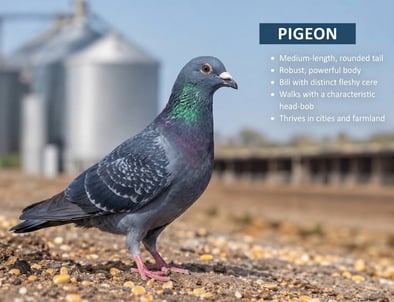
If the customer is describing larger gray birds sitting on rooftops, ledges, beams, or around grain-handling structures, you may be dealing with pigeons rather than starlings.
You don't have to pull out a field guide every time.
Try this:
“Are they the short-tailed ones that walk around, or the long-tailed ones with the keel tail?”
That question can immediately give you more information.
If they're short-tailed, compact birds walking around in a large flock, start thinking starling.
If they're noticeably larger with a long, keel-shaped tail, think grackle.
If they're chunky gray birds hanging around buildings, rooftops, ledges, or grain structures, pigeon becomes much more likely.
And if the customer isn't sure?
Ask them to take a picture.
A phone photo can be much more useful than trying to identify a bird from:
“They're black.”
This isn't about showing off your bird knowledge.
It's about understanding the customer's actual situation.
Different birds can behave differently.
They can use different areas of an operation.
They can respond differently to pressure.
And bird-control products and applications aren't interchangeable simply because two birds happen to look similar.
For agricultural sales teams, that means don't jump from “blackbirds” straight to a product recommendation.
First determine what the customer is actually seeing.
Then consider:
What bird is it?
Where are they concentrating?
What are they eating?
Where are they roosting?
How many are there?
Are they increasing?
What is attracting them?
Those questions give you a much better picture of the problem.
The next time an ag customer tells you:
“We've got blackbirds everywhere.”
Don't immediately think product.
Think identification.
Ask:
“What kind of birds are you seeing?”
Then look for the clues.
Short-tailed and walking around? Think starling.
Long-tailed with that distinctive keel shape? Think grackle.
Chunky gray bird around buildings and structures? Think pigeon.
You don't have to be an ornithologist.
You just need to know what to look for and ask the right questions.
Because when it comes to bird control:
The better you identify the bird, the better you can understand the problem.